ClipRipper
A fully automated AI pipeline that transcribes, edits, and renders short-form clips end to end.
Overview
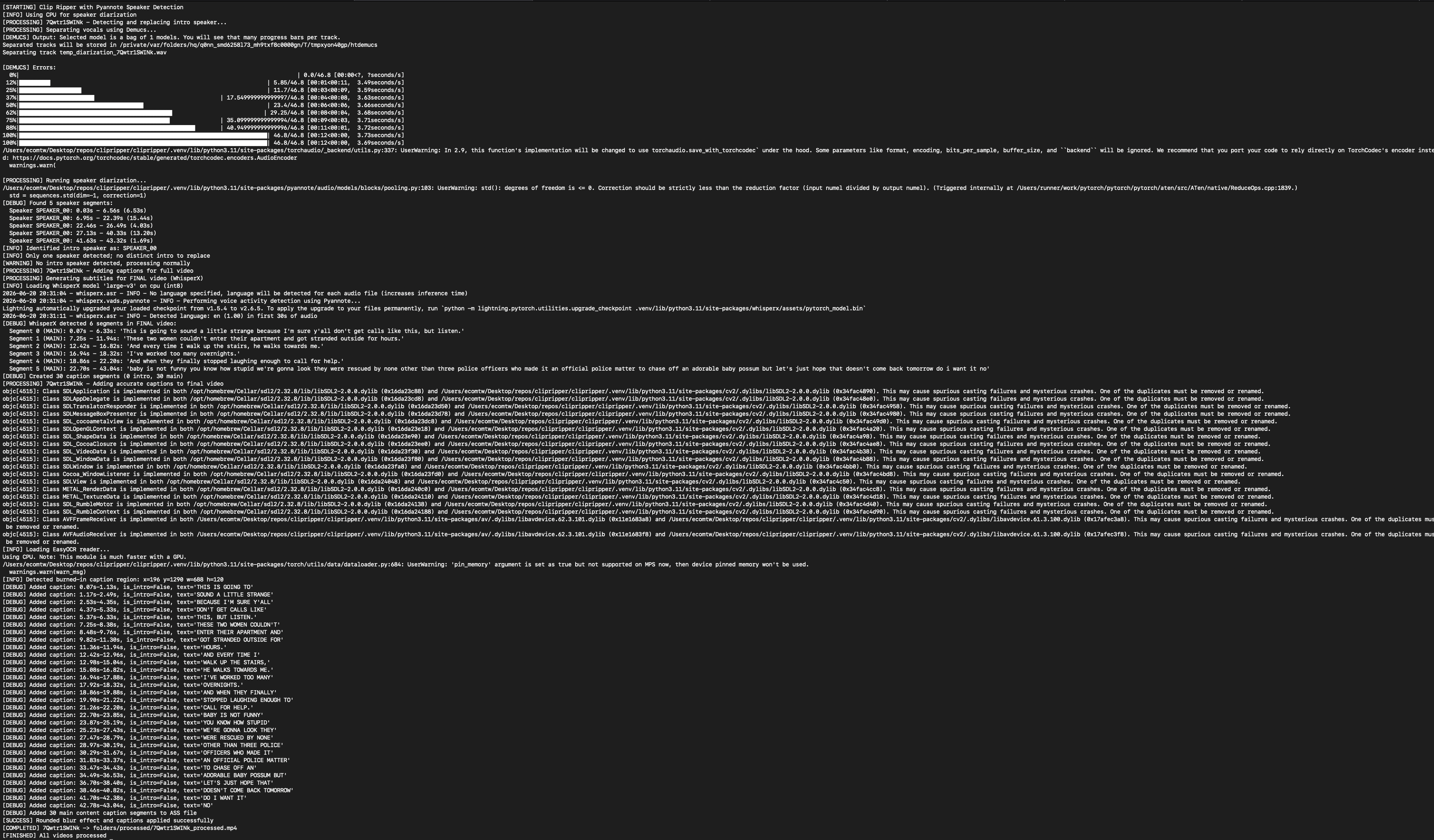
ClipRipper is a fully automated video generation and editing pipeline that transcribes, edits, and renders short-form clips end to end using AI and machine learning. I built it during summer 2025 working as a Python Developer, with the goal of taking raw footage all the way to a finished, rendered clip without a human sitting in an editor for every step.
The pipeline is orchestrated in Python and leans on a stack of specialized tools for each stage: WhisperX handles speech transcription, moviepy and FFmpeg handle programmatic video editing and rendering, and pyannote and ElevenLabs cover the audio side, from analyzing speech to generating AI voice audio. Machine learning models come through the HuggingFace ecosystem, a SQLite3 database manages the pipeline's data, and integrations with multiple external APIs, including Google and Meta, connect the system to the outside world.
Just as important as the tech, this project was a lesson in building software with other people. I learned how to design, manage, and merge a shared pipeline while collaborating with teammates, how to structure a database with sqlite3 to keep every stage in sync, and how to wire together video, audio, and API tooling into one reliable, hands-off system.
Key Features
- End-to-end automation. The entire flow from source video to rendered short-form clip runs as one automated pipeline, with no manual editing required between stages.
- AI transcription with WhisperX. WhisperX converts speech to text, giving the pipeline a machine-readable understanding of the footage that downstream editing stages can work from.
- Intelligent audio processing. pyannote powers audio analysis on the editing side, while ElevenLabs generates AI voice audio, so the pipeline can handle both the source sound and synthesized speech.
- Programmatic video editing. moviepy and FFmpeg cut, assemble, and render clips entirely in code, turning editing decisions into repeatable pipeline steps.
- SQLite3-backed pipeline state. A SQLite3 database I designed and managed keeps track of the pipeline's data so every stage stays in sync as clips move through the system.
- Multi-API integration. The pipeline works with multiple external APIs, including Google and Meta, to connect the automated workflow to outside services.
How It Works
- A source video enters the pipeline, which is orchestrated end to end in Python.
- WhisperX transcribes the audio into text, using machine learning models from the HuggingFace ecosystem.
- pyannote analyzes the audio, and ElevenLabs generates AI voice audio where the clip calls for it.
- moviepy and FFmpeg programmatically edit the footage, cutting and assembling the short-form clip.
- A SQLite3 database tracks the pipeline's data as clips move between stages.
- FFmpeg renders the finished clip, and external APIs such as Google and Meta connect the output to outside services.